

Monumental Families: A Nascent Trend in Memorials to Enslaved Peoples?
By Dr. Kevin M. Anzzolin •
Few subjects have been argued so persistently in slavery studies as the status of the Black family. Debates have long centred on how stable the enslaved family was and how far the institutions of U.S. chattel slavery broke down familial bonds. One of the first scholars to weigh in, W.E.B. Du Bois, argued in The Negro American Family (1908) that the hardships he observed among Black families were rooted in social and historical conditions rather than innate racial traits:
This is what slavery meant, and no amount of kindliness in individual owners could save the system from its deadly work of disintegrating the ancient Negro home and putting but a poor substitute in its place (p. 37)
Scholars have debated the question ever since. E. Franklin Frazier (1939) argued that slavery stripped captives of their kinship systems; Melville Herskovits (1941) countered that African traditions survived even amid slavery’s cruelties; and Herbert Gutman (1976) used census data to show that two-parent households were, in fact, durable. Regardless of these diverse historical arguments, midcentury federal policies in the U.S. reflected the thesis that Black families had suffered centuries of systematic degradation. In “Conceptualizations of Black Families,” Jualynne Dodson summarises that the work of such scholars
culminated in the adaptation of social policies predicated on the assumption that the black family is unstable, disorganized, and unable to provide its members with the social and psychological support and development needed to assimilate fully into American society (Dodson, 1988, p. 77)
Public sculpture has entered this conversation. The present moment is, arguably, one of unprecedented public willingness in the United States to memorialise the horrors of slavery; the killing of George Floyd in Minneapolis in 2020 marked an inflexion point in that reassessment. Over the past two decades, abstract works, “anti-monuments,” and statues honouring abolitionists such as Harriet Tubman, Sojourner Truth, and Frederick Douglass have become prominent, and interventions at historical sites and burial grounds have also multiplied. Yet, a survey of monuments created over roughly the last thirty years suggests a further trend: sculptures that grapple with the place of the family in the lives of the enslaved.
Many of these public works, which combine reparative intent with memory-making, are documented in the ambitious online database Contemporary Monuments to the Slave Past (CMSP). The database organises its holdings under a wide range of thematic headings: sites of slavery, emancipation, resistance, the transatlantic slave trade, African American history, universities and slavery, burial grounds, the abolition of slavery, the Underground Railroad, the United States Colored Troops, and Black abolitionists. The database’s taxonomy is both comprehensive and accurate, yet it leaves a notable gap: Again, the Black family. Sculptors have increasingly depicted families in bondage or on the road to freedom, most often mothers and children, but also husbands and wives and, in a few cases, three generations together. These public images are revising what scholarship and popular memory have long assumed about the enslaved household. Here, escape is not enough: The family unit itself is central to freedom.
Examples of this nascent trend in memorials to enslaved peoples began to appear at the turn of the millennium. In Boston, Fern Cunningham’s bronze relief for the Harriet Tubman Memorial (1999) shows Tubman leading a multigenerational family of freedom seekers. In Detroit, a detail of Ed Dwight’s Underground Railroad memorial, Gateway to Freedom (2001), shows a mother comforting her child before they cross the Detroit River.
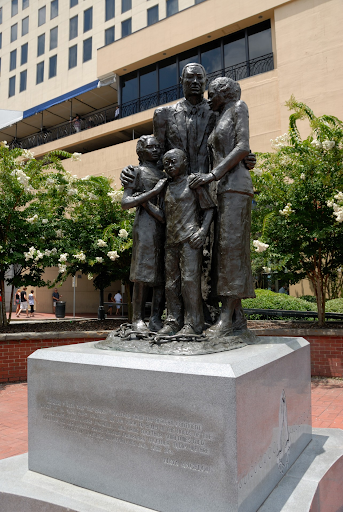
Dorothy Spradley’s African-American Monument in Savannah (2002) is the clearest variation on the familial theme: a father, mother, daughter, and son embrace while standing on broken chains. In Lewiston, New York, Susan Geissler’s Freedom Crossing Monument (2009) arranges its bronzes around a freedom-seeking family of father, mother, and baby in a rowboat.
Yet, this emphasis on the family on the move comes with a complication: in Runaway Slaves: Rebels on the Plantation, scholars John Hope Franklin and Loren Schweninger (1999) have found that most runaways were young men travelling alone, because
Perhaps the most difficult task was for an entire family—husband, wife, children, grandparents, grandchildren—to try to escape together…The larger the group, the greater the possibility of being observed (p. 66)
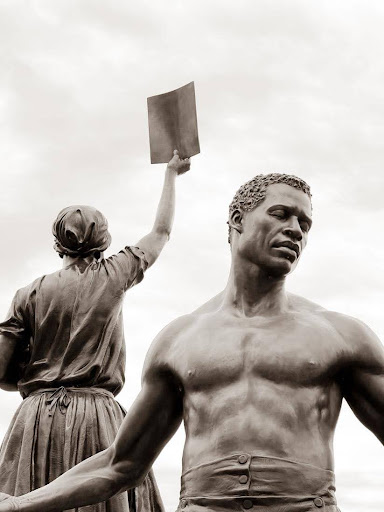
These patterns (and challenges) continue in the twenty-first century. In Lorain, Ohio, a low relief statue titled the Underground Railroad Station 100 Monument (2007) depicts a father, mother, and young boy ostensibly walking to freedom. Richmond’s Emancipation and Freedom Monument (2021, Thomas Jay Warren) also forcefully develops the theme. It presents a man and woman holding an infant after being freed, placing the family unit at the centre of what emancipation means.
Yet other statues around the US have, in recent years, represented enslaved families. Kwame Akoto-Bamfo’s Mama, I hurt my hands (2024), at Montgomery, Alabama’s Freedom Monument Sculpture Park, shows a child presenting an injured hand to his mother, who carries a cotton basket and an infant: a family living inside slavery. In Lexington, Kentucky, Towards Freedom (2025) honours Harriet and Lewis Hayden, who escaped slavery there and later became leading abolitionists.
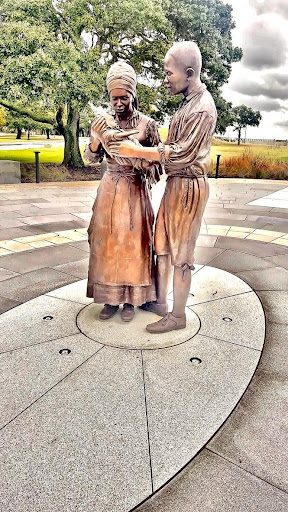
The newest example of a statue dedicated to an enslaved family stands at Fort Monroe in Hampton, Virginia, a locale that received the first documented Africans in English North America in 1619. The African Landing Memorial plaza was dedicated on April 24, 2026. The statue, simply titled The Figures, portrays Antoney and Isabella, who arrived from Angola aboard the White Lion, with their son William, recorded as the first child of African descent born and baptised in the English colonies, in 1624 (Holly, 2026). Isabella cradles the infant as she and Antoney look longingly at their progeny. Antoney stands beside her, helping her to steady the baby. Two more installations at the Hampton site will follow (Holly, 2026). The statue is both memorial and monumental, as it elevates an individual family even while commemorating the birth of a new civilisation: Effectively, all of Black America began here.
If this is indeed a trend in public art, it answers Du Bois differently from the pathology debate. Rather, this nascent trend in sculptures argues that the Black family endured and is central to public space. Importantly, this tendency in monumentalization may also speak to the central role of Black joy, conceived not as passive escape but as an active mode of opposition, endurance, and recovery. By showing intimacy, endurance, and parental tenderness against a backdrop of historical struggle, the sculptures present Black family bonds as a powerful statement of human dignity and survival.
About the author
Dr Kevin M. Anzzolin, Lecturer of Spanish, arrived at Christopher Newport University in Virginia, USA, in 2021, where he teaches a wide range of classes. His book, Guardians of Discourse: Literature and Journalism in Porfirian Mexico, was published with the University of Nebraska Press in May 2024 and garnered an Honourable Mention from LASA-Mexico for Best Book in the Humanities in 2025, as well as an Honourable Mention for the MLA Prize for Contingent Faculty and Independent Scholars in 2026. His research focuses primarily on Mexican culture from the 19th to 21st centuries. He is active in public scholarship as well, having written about pedagogy, pop culture, and local politics in different fora.
References
Contemporary Monuments to the Slave Past. Browse collections. https://www.slaverymonuments.org/collections/browe
Dodson, J. (1988). “Conceptualizations of Black Families.” In H. P. McAdoo (Ed.), Black families (2nd ed., pp. 77–90). Sage.
Du Bois, W. E. B. (Ed.). (1908). The Negro American family. Atlanta University Press.
Franklin, J. H., & Schweninger, L. (1999). Runaway slaves: Rebels on the plantation. Oxford University Press.
Frazier, E. F. (1939). The Negro Family in the United States. University of Chicago Press.
Gutman, H. G. (1976). The Black Family in Slavery and Freedom, 1750–1925. Pantheon.
Herskovits, M. J. (1941). The Myth of the Negro Past. Harper & Brothers.
Holly, E. (2026, August 30). “Virginia’s first African American family honored with new sculpture.” WTVR CBS 6.
McQueen, S. (Director). (2013). 12 Years a Slave [Film]. Fox Searchlight Pictures.
Tarantino, Q. (Director). (2012). Django Unchained [Film]. The Weinstein Company.
The Optimist Daily. (2021, September). “Richmond, VA Unveils Emancipation and Freedom Monument.” https://www.optimistdaily.com/2021/09/richmond-va-unveils-emancipation-and-freedom-monument/
Images
Dorothy Spradley’s African-American Monument in Savannah (2002). Image by Paul Brennan via Public Domain Pictures. CC0 Public Domain.
Richmond’s Emancipation and Freedom Monument (2021). Image by Tangie Bodden via Pexels. CC0 Public Domain.
Hampton’s The Figures. Photo courtesy of the owner.
The views expressed in this blog are solely those of the author and do not necessarily reflect the views of EuroClio, the Contested Histories Initiative or any of its affiliates. Neither EuroClio nor the Contested Histories Initiative can be held responsible for them.
Related Items

Monument(al) Challenges in Focus: Report from Northern Ireland
Reflections from Belgrade workshop on teaching contested histories
